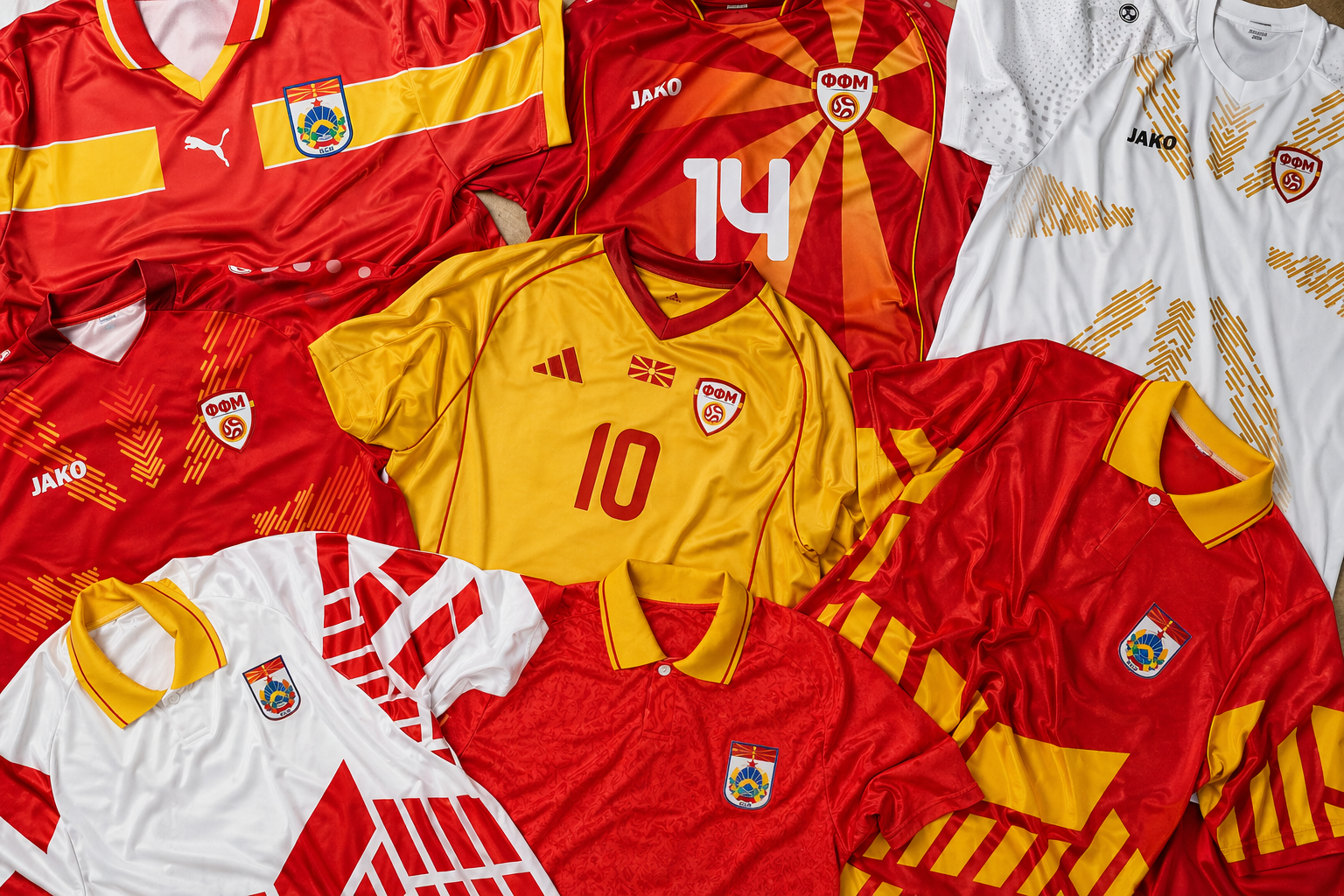
A palette under pressure
Most national-team shirts are asked to do a few simple things: read clearly on television, flatter the sponsor, move merchandise, maybe flatter the past. Macedonia’s shirts have had a heavier assignment. Since independence in 1991, the country’s public symbols have been repeatedly revised, contested, or internationalized. The flag changed in 1995 under Greek pressure. The country’s name changed under the Prespa Agreement in 2018. Even the initials on the crest became a matter of complaint during the European Championship in 2021.
That history helps explain why Macedonian shirts are not merely sportswear. They are visual arguments. Their success depends on more than cut or trend. They have to solve a harder design problem: how do you make a nation legible to itself?
Over the past three decades, five shirts have answered that question in distinct ways. Taken together, they show a clear evolution—from color as identity, to geometry as signal, to iconography as system, to a brief and failed symbolic detour, and finally back to the most stable language of all: red, yellow, and the sun.
From color to composition
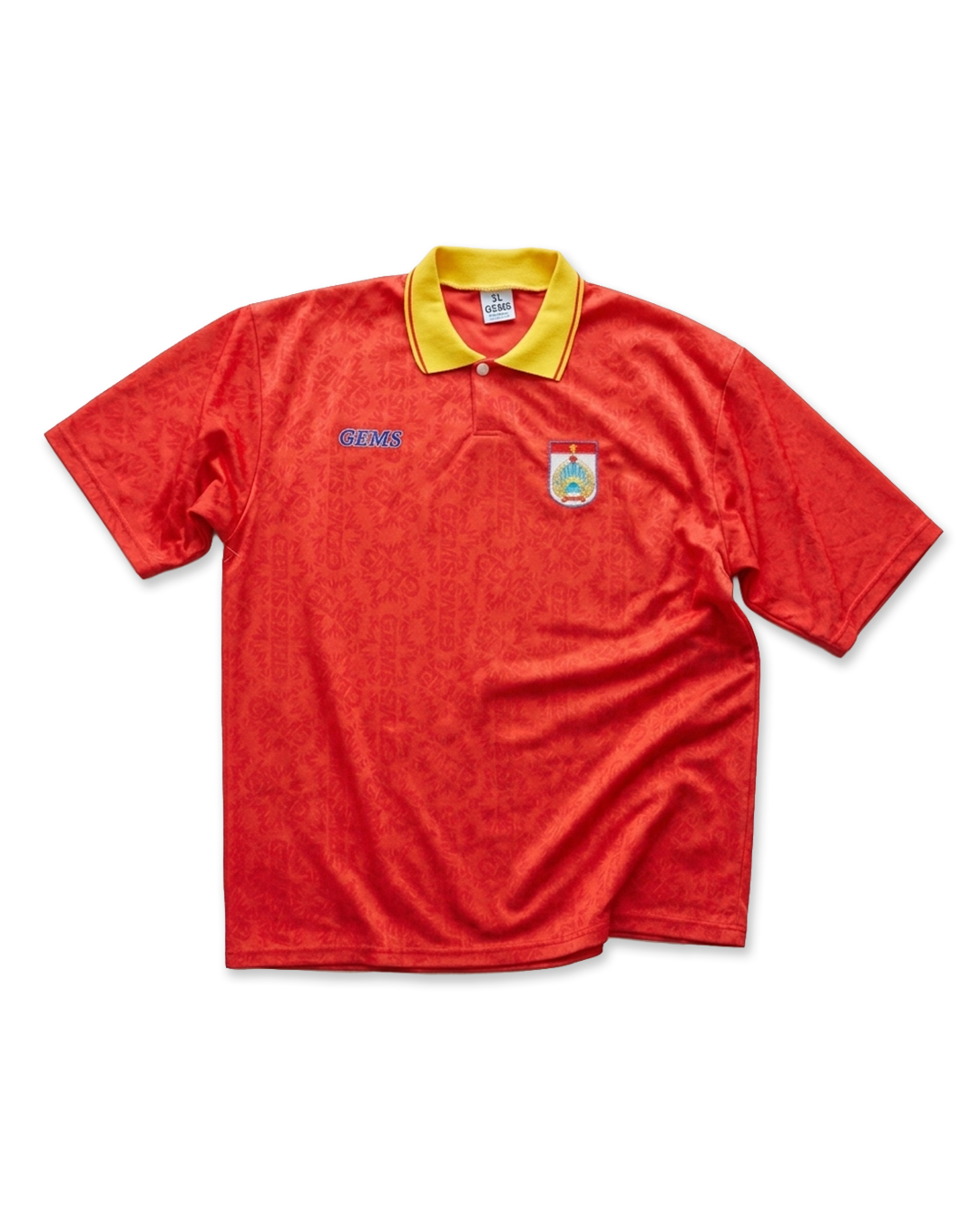
The 1994 Gems home shirt is the right place to begin because it is so restrained. Red body, subtle jacquard texture, yellow polo collar, white buttons. By contemporary standards, it is almost anti-graphic. It does not dramatize the state. It does not turn the torso into a billboard for national mythology. It simply establishes the palette.
That modesty is part of its intelligence. In a new footballing nation, appearing in competition in unmistakable red and yellow already carried symbolic weight. The shirt did not need to illustrate Macedonia. It only needed to wear it. For a design audience, the lesson is familiar: a system often begins not with expression but with discipline. Before the symbol becomes explicit, the palette has to become undeniable.
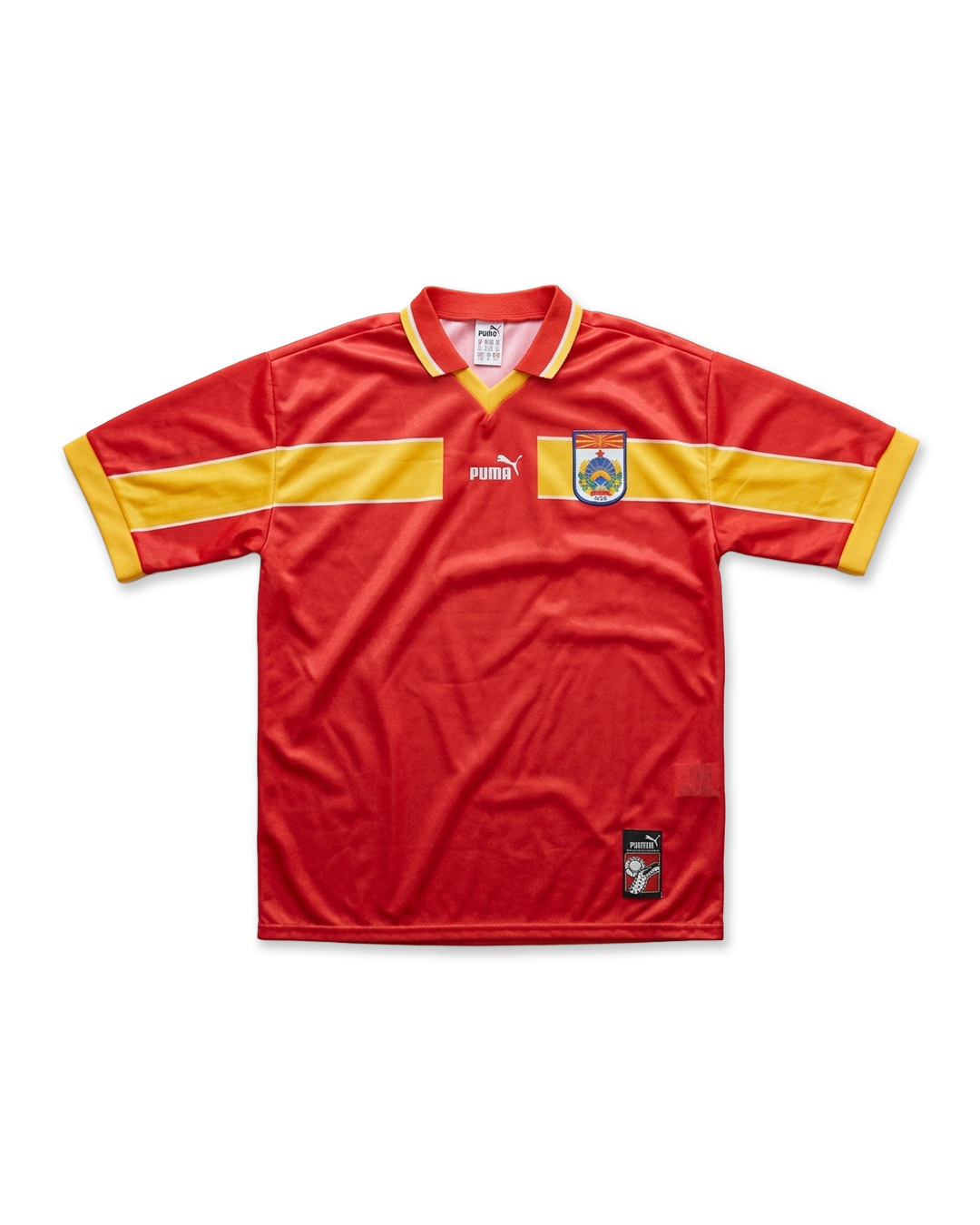
The 1998 Puma home shirt moved from discipline to signal. Here the red base is interrupted by a bold yellow horizontal band across the chest and sleeves, with yellow cuffs and a red-yellow V-neck. The effect is sharper, louder, and much more modern. If the Gems shirt used color as accent, the Puma shirt used it as structure.
This is the first Macedonian shirt that feels fully tuned to broadcast-era design. The yellow band reads like a banner, a piece of visual shorthand that works at distance, in motion, and under stadium lights. It also marks the team’s transition into the template culture of late-nineties global sportswear. Yet the shirt never loses specificity. It borrows Puma’s commercial grammar, then bends it toward a distinctly Macedonian message. Red and yellow are no longer just present; they are organized for legibility.
That distinction matters. Good kit design is not only about symbolism. It is about hierarchy. What reads first? What survives motion blur? What can be recognized from the upper deck or a paused replay? The 1998 shirt understood that national identity, on a football field, is partly a problem of contrast.