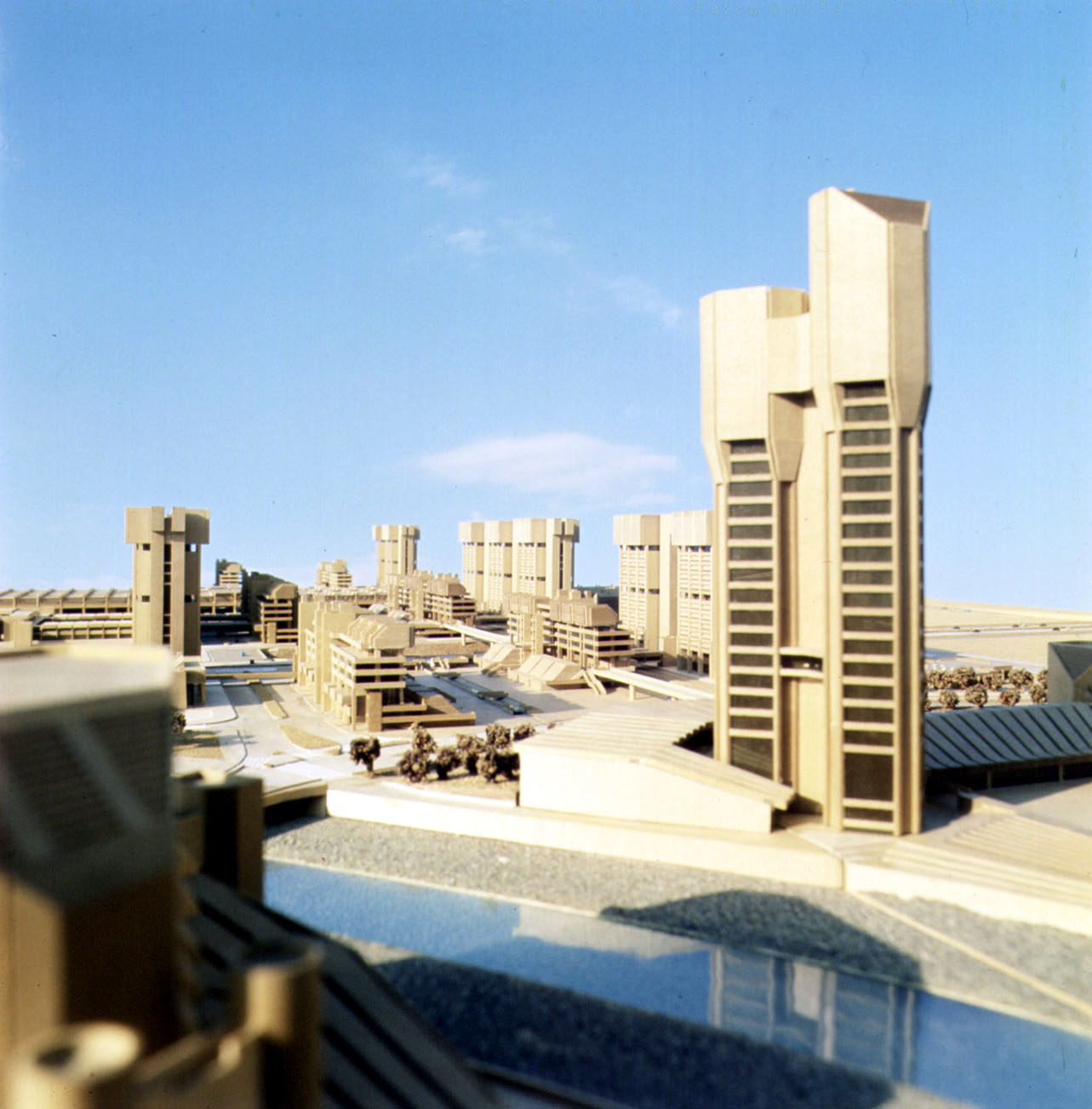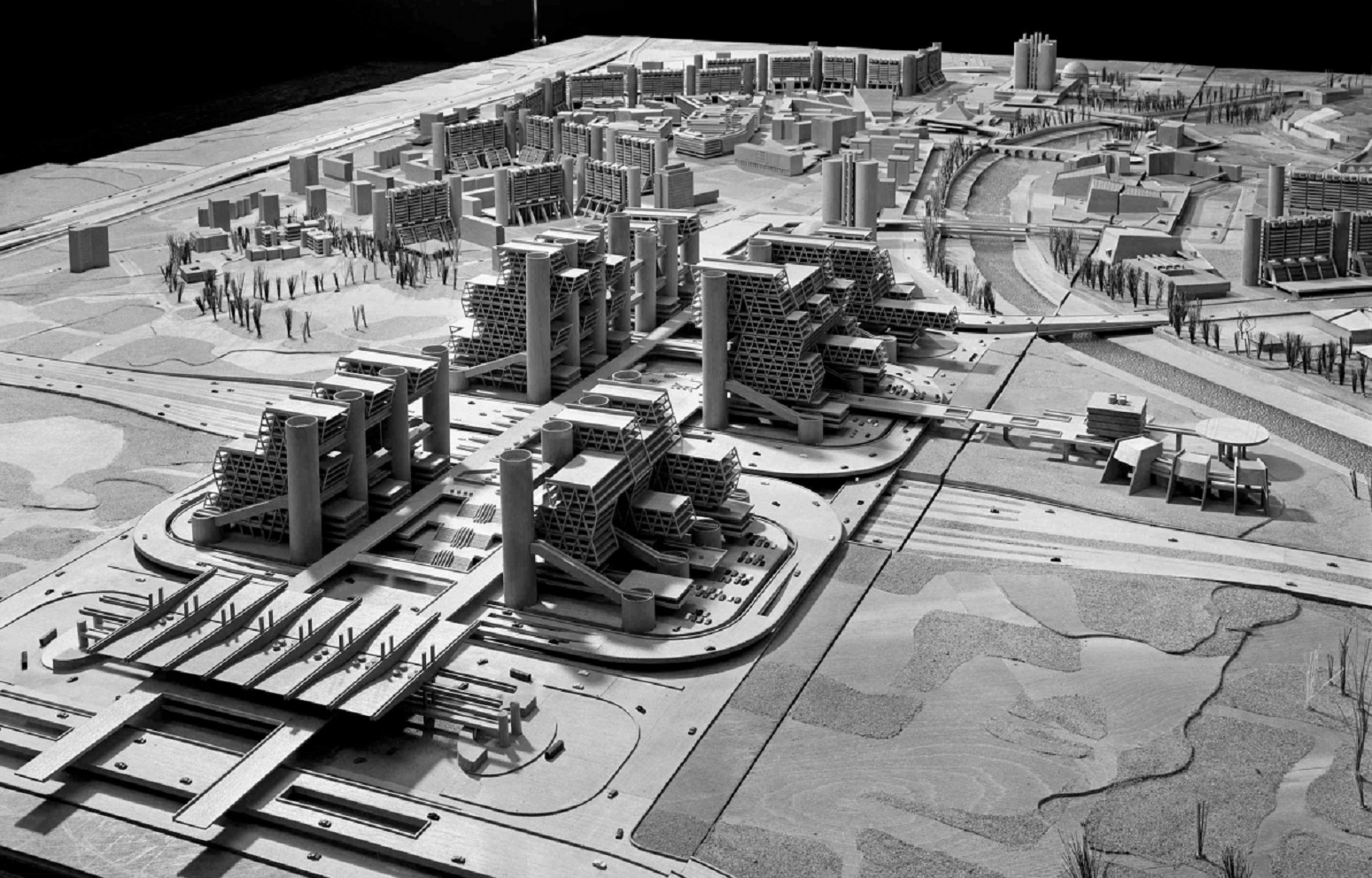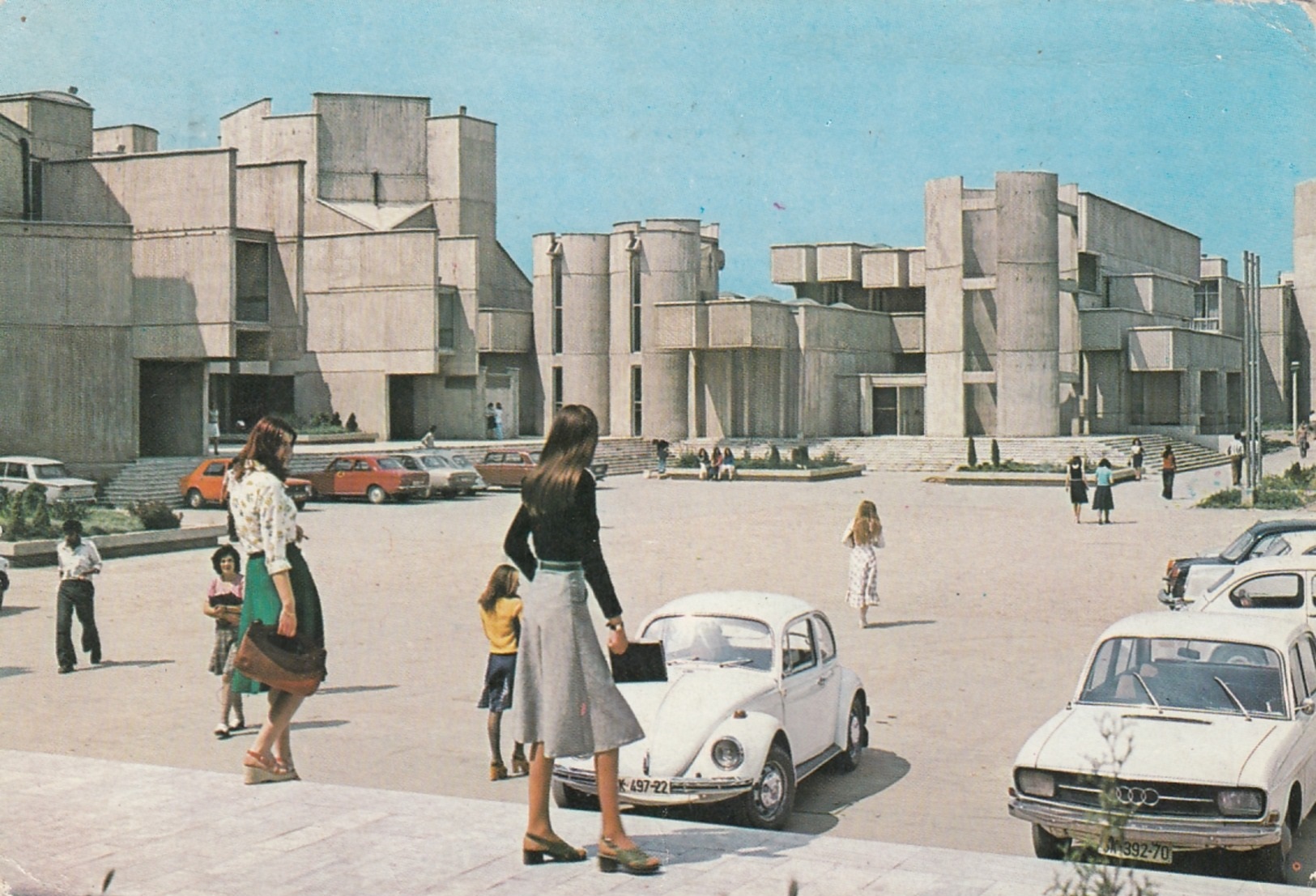
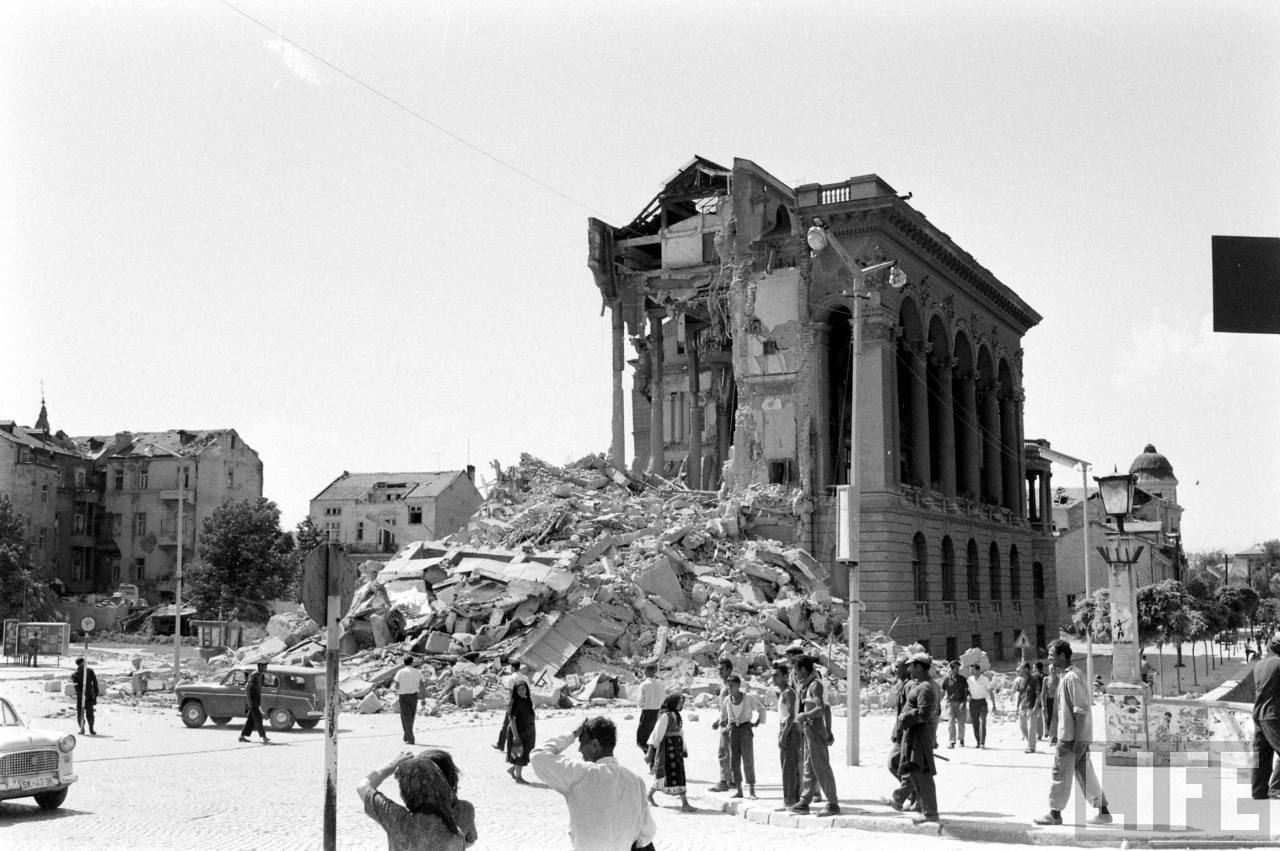
On 26 July 1963, Skopje was struck by the earthquake that changed its architectural destiny. About four-fifths of the city was left in ruins; 1,070 people were killed, and relief arrived from 78 countries. What emerged from that catastrophe was not only a reconstruction campaign, but one of the most ambitious urban experiments of the postwar period: a city remade through the combined languages of disaster engineering, international planning, and modern architecture. Skopje was suddenly not just a Macedonian city in Yugoslavia. It became a world site.
That technical dimension matters more than it is usually given credit for. Skopje was not rebuilt as a purely symbolic tabula rasa for heroic modernism. Under Yugoslav and UNESCO auspices, the city hosted an international seminar on earthquake engineering in 1964, with seismologists, planners, and structural experts treating reconstruction as a problem of ground conditions, structural resistance, and urban safety as much as one of form. Architecture in Skopje began, quite literally, with the earth.
It was also a geopolitical anomaly. Yugoslavia’s non-aligned position allowed Skopje’s reconstruction to become a rare Cold War contact zone in which global development agencies, foreign experts, and local institutions could collaborate without the city being neatly absorbed into either bloc. Scholarship on the project has since described it as an instance of “non-aligned internationalism,” while contemporary UN language cast the rebuilt Macedonian capital as a symbol of international solidarity and friendship among peoples. That context is essential, because it explains why a Japanese architect could become central to the remaking of a Macedonian capital.
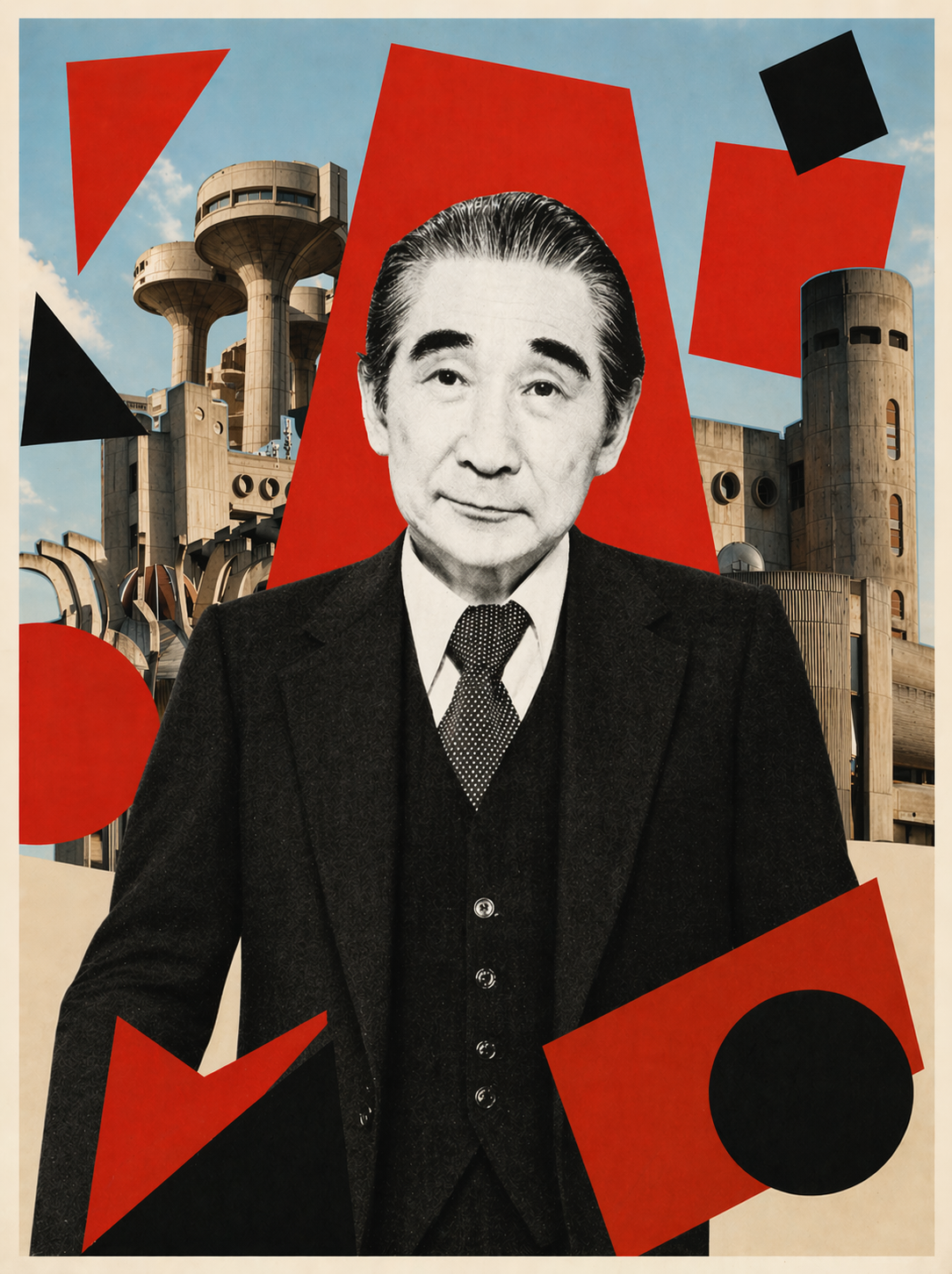
Kenzo Tange entered this story already as one of the decisive architects of the twentieth century. Born in Osaka in 1913, educated at Tokyo Imperial University, inspired early by Le Corbusier, and trained in the office of Kunio Maekawa, he came out of the major channels of modernism without ever becoming merely a Japanese translator of European doctrine. After the war he won the competition for Hiroshima Peace Memorial Park, gained international attention through CIAM, and established himself not only as an architect of buildings but as a thinker of cities.
His significance lies as much in pedagogy as in built work. From 1946 to 1974 he taught at the University of Tokyo and led the Tange Laboratory, which became a generator of postwar Japanese architecture and helped form figures such as Fumihiko Maki, Arata Isozaki, and Kisho Kurokawa. Tange was therefore not simply an individual author. By the early 1960s he was an institution, a school, and a launching point for a new urban imagination.
By the time Skopje invited him into its reconstruction, Tange had already built the works that made his authority unavoidable. Hiroshima gave him a language of postwar civic symbolism. Yoyogi National Gymnasium showed that he could turn structural daring into public form. His 1959 doctoral work on the “spatial structure” of the large city, followed by Plan for Tokyo 1960, pushed him beyond object-buildings toward a theory of the metropolis organized through movement, communication, and large-scale infrastructural order. The city, for Tange, was no longer something to be composed like a picture. It was something to be structured like a system.
This is where Metabolism has to be understood with precision. Metabolism was not a style of futuristic concrete, nor merely a taste for megastructures. The manifesto Metabolism: The Proposals for New Urbanism was published in Tokyo in 1960 around the World Design Conference, and the movement was defined by the idea that cities should be understood according to organic, not mechanical, paradigms. Kisho Kurokawa later described it as a biological analogy meant to replace the machine analogy of orthodox modernism. For architects, that shift was radical: the city was no longer a finished artifact but a process of growth, renewal, replacement, and adaptation over time.
The deepest architectural proposition of Metabolism was the distinction between what should endure and what should change. Long-life infrastructural frames, service cores, circulation trunks, and territorial armatures would provide continuity. Short-life units—housing cells, commercial modules, programmatic inserts—could be replaced as needs changed. In that sense, Metabolism was a theory of urban time disguised as a theory of form. It asked how architecture could make permanence and change coexist without collapsing either into chaos or into dead order.
Tange was older than the younger architects usually named as the core Metabolists, but he was their intellectual hinge. His laboratory produced many of them, his urban work prepared the ground for them, and his theory of communication-based infrastructure gave the movement its most convincing metropolitan scale. Skopje mattered because it offered him something Tokyo never quite did: the chance to test these ideas on a real city center rather than in a visionary proposal.
That competition, though, sat inside a much larger reconstruction apparatus. The rebuilding of Skopje was financed and coordinated through a layered UN and Yugoslav process that extended well beyond the city-center scheme, including surveys, housing studies, and master-planning work by several international actors, most notably Constantinos Doxiadis. Tange’s proposal became the most vivid image of the reconstruction, but it was never the whole story. Skopje was being reimagined through a broader transnational framework whose ambition exceeded any single authorial vision.