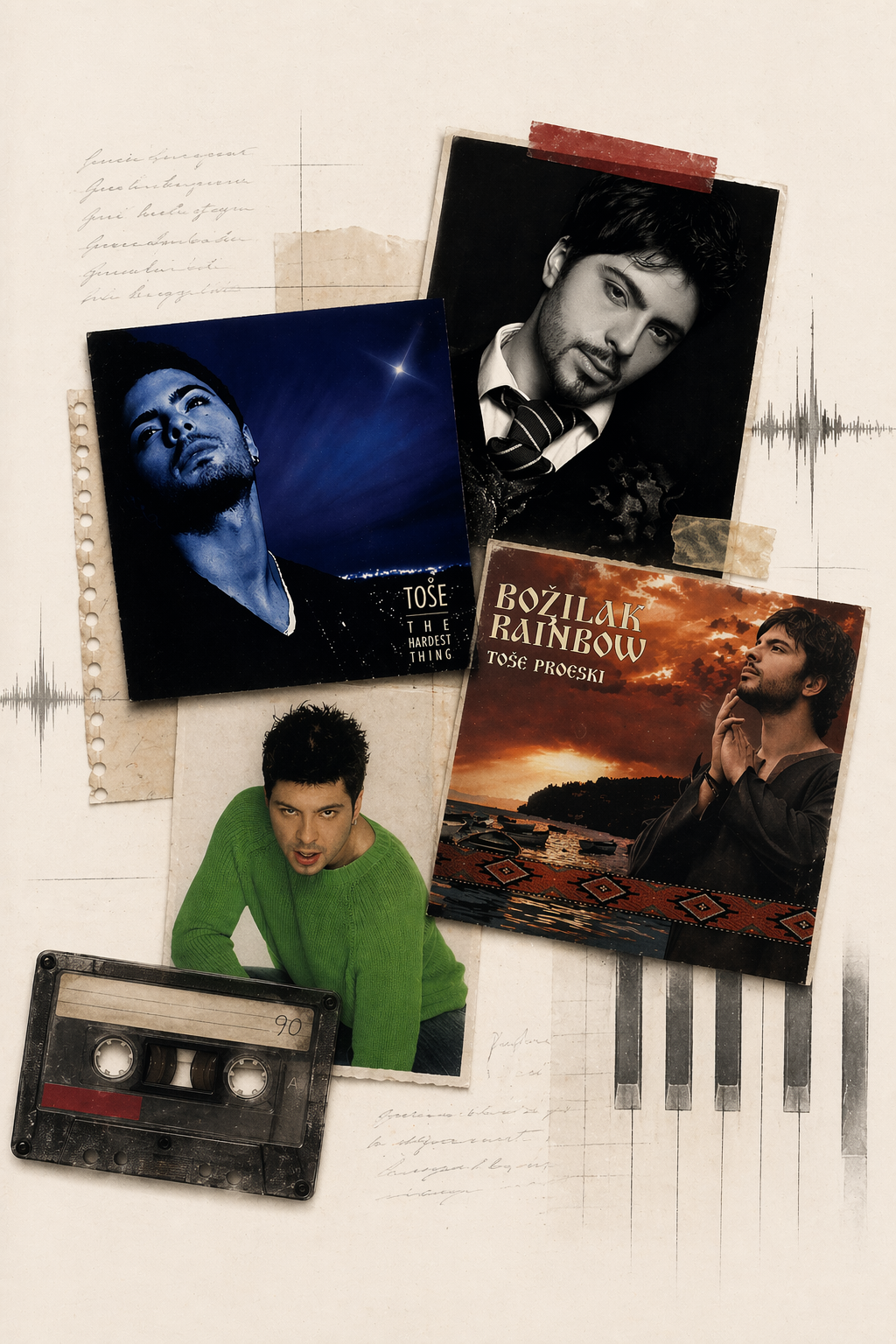
Collage of Toše Proeski photographs, album covers, cassette tape, and music ephemera

Toše Proeski
and the
Making of
The Hardest
Thing

A singer still expanding the possibilities of his own voice.

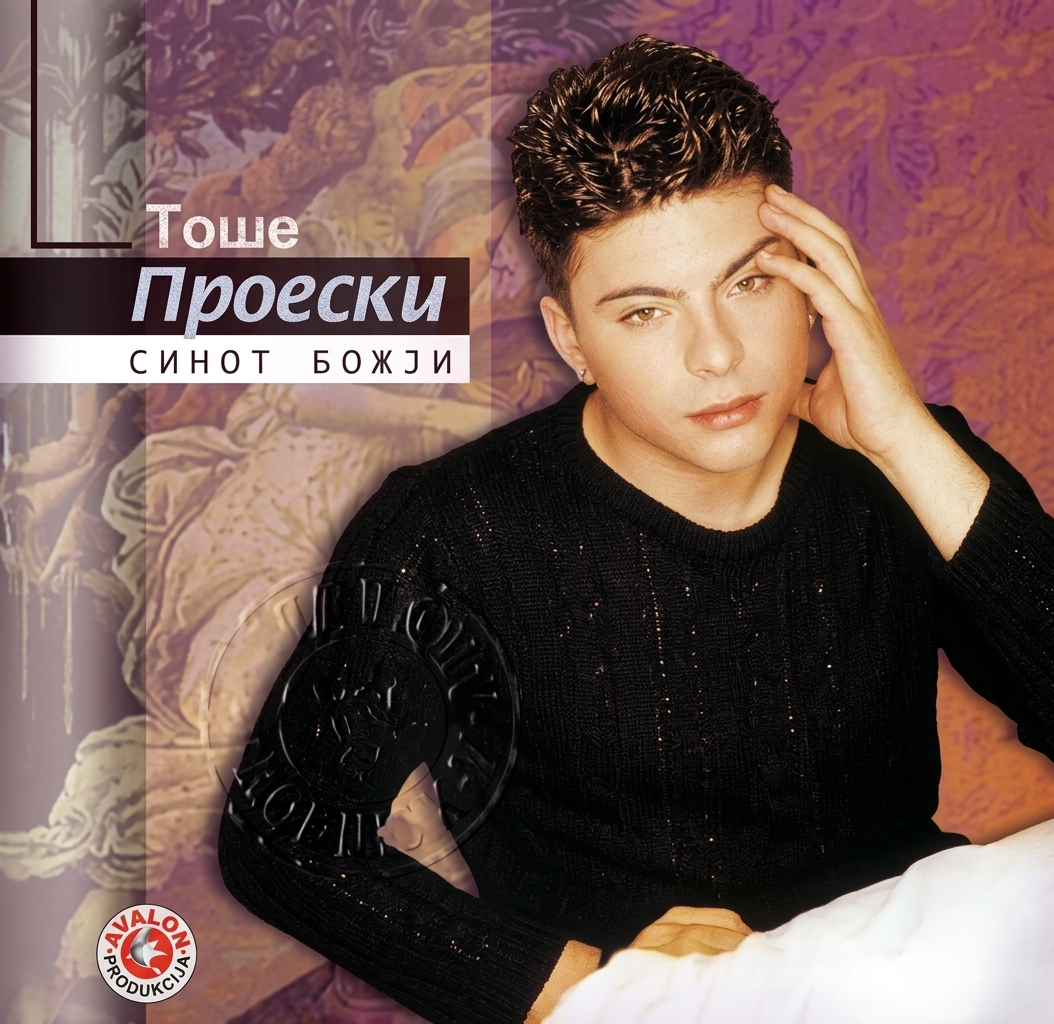
Toše Proeski Sinot visual

The best way to understand Toše Proeski is not through the tragedy that fixed him in public memory, and not even through the early fame that made him a star. It is through the way he made songs: at a keyboard, from nothing, feeling for a melody before the words had fully arrived. By the time The Hardest Thing was released on January 25, 2009, more than a year after Proeski died in a car accident on October 16, 2007, the album had already taken on the solemn weight of an ending. But it was not conceived as one. It was built as a beginning: a serious international crossover record, shaped in London, Jamaica, and Sweden, with documentary footage and producer testimony to prove that this was not a memorial assembled after the fact, but the visible crest of an unfinished career that had been moving outward with unusual speed.

That speed matters. Official biography places Proeski’s first notable public appearance at the children’s festival Golden Nightingale in 1992. By the late nineteen-nineties he had passed through the festival circuit that still functioned, in that region, as both conservatory and proving ground: Melfest, Makfest, Skopje Festival, Ohrid Troubadours, Eurofest. These were not minor preliminaries. They taught him how to project feeling to the back of a hall without flattening it into mere volume. In 1999 came Nekade vo noḱta, released by Avalon. In 2000 came Sinot Božji, with “Tajno moja” and “Nemir,” which helped make him, very quickly, more than promising. By then the essentials were in place: the lyrical romanticism, the long melodic rise, the voice that could sound both intimate and public at once.

What followed was not simply success but expansion. In 2002, after the Avalon period, Proeski signed with Final Cut, worked in Athens, and released the bilingual Ako me pogledneš vo oči / Ako me pogledaš u oči. That record formalized the model that would define the rest of his career: Macedonian and Serbo-Croatian editions, region-wide promotion, and a network of collaborators spanning Skopje, Belgrade, Athens, Zagreb, and beyond. Phoebus brought Greek chart-pop polish; Manolis Vlahos produced the album; Marina Tucaković helped make the songs land in Serbian-language markets. Then came the Beovizija win with “Čija si” in 2003, followed by Eurovision in 2004 with “Life.” Proeski was no longer only a Macedonian star. He had become a Balkan superstar.

He continued to expand. Den za nas / Dan za nas consolidated the Eurovision moment. Po tebe / Pratim te became one of the defining regional pop releases of its era. Božilak turned deliberately back toward Macedonian traditional songs, treating them not as quaint inheritance but as material worthy of symphonic arrangement. Igri bez granici / Igra bez granica pushed him toward a larger, more rock-inflected anthem style. In parallel, he studied at the Faculty of Musical Arts in Skopje, took lessons from William Riley, and deepened his humanitarian role through UNICEF. The official account of his life presents those strands—training, fame, service—not as separate stories, but as parts of the same one.

All of which leads back to The Hardest Thing, because that album gathered the threads into one place. Andy Wright’s first-person account of working with Proeski is especially revealing. Their sessions did not begin with polished material waiting to be recorded. They began from zero. Wright would sit at a keyboard or piano and Toše would improvise—scatting, searching, trying out sounds in English and Macedonian until a melodic line began to declare itself. Demos were captured quickly; only the strongest ideas survived. That method explains why so many Proeski songs feel as though they were composed from the voice outward. The topline is never an ornament laid over the track. It is the track’s reason for existing.
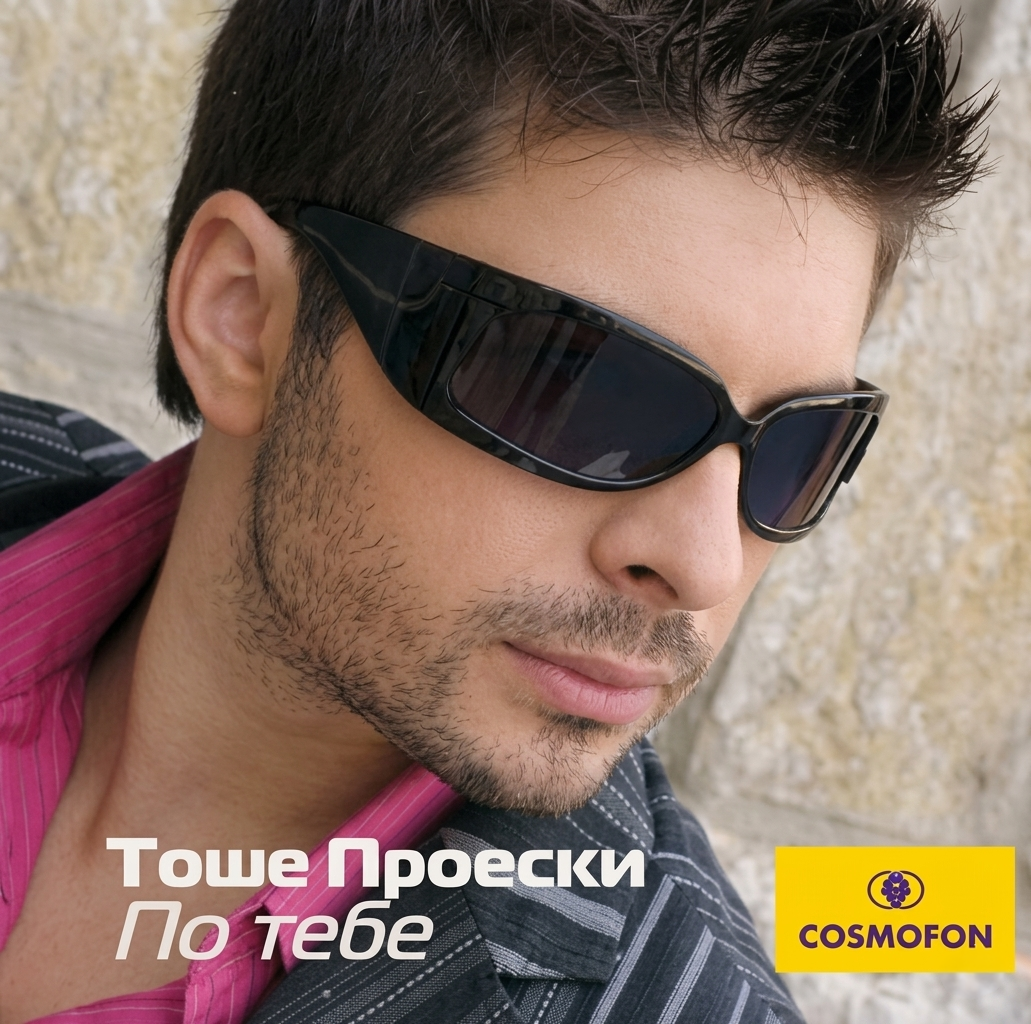
Toše Proeski Po Tebe visual

This is also why the album’s international sheen never turns anonymous. Wright’s recollections place Proeski inside a serious crossover network, with sessions in London and Jamaica and later work involving Scandinavian and British pop writers and producers, including Wayne Hector, Mikael Nord Andersson, and Martin Hansen. There was also “Aria,” which pulled him into Italian classical-crossover territory through Gianna Nannini, Francesco Sartori, and the arranger Will Malone. Yet even as the production world widened, the deepest habit of the music stayed the same. Proeski remained a singer of extended melodies, delayed release, and choruses that open like a held breath finally breaking. The album may have been designed to travel, but it was still powered by the same emotional architecture that had defined his Balkan repertoire.

The title track makes the point most clearly. Public transcriptions reduce “The Hardest Thing” to a globally legible minor-pop loop, centered around A minor with familiar rock-ballad motion, and place it at roughly eighty-five beats per minute. Compared with the denser regional fingerprints of songs like “Tajno moja” or “Čija si,” this is strikingly simple. But the simplicity is strategic. Harmonically, the song is portable: it can move easily through London, Stockholm, or Nashville without explanation. Emotionally, it remains heavy with the moral and melodic seriousness that listeners already associated with Proeski. The verse stays close to speech; the chorus widens into lament. Guitars and rhythm section frame the song as contemporary adult pop-rock, while strings and layered ambience preserve the sense of grandeur. This is crossover music, but not at the cost of identity.

Formally, the song behaves like a modern rock ballad: restrained verse, rising connective section, chorus with widened vowel space, bridge, then a final chorus engineered for maximum lift. The melody is not especially complex intervallically, but it is strategically placed. The verse sits closer to speech and breath; the chorus lengthens note values and lets Proeski lean into the upper part of the line. In production terms, the arrangement does exactly what a crossover launch single should do: guitars and rhythm section frame the track as contemporary adult pop-rock, while strings and layered vocal ambience preserve the grand, elegiac feeling his audience expected from him.

Wright’s account of the later songs sharpens that picture. “When I’ve Got the Sunlight” grew out of an early home demo that already contained melodic material but no finished lyric. “If You Wanna Leave” had to be rescued from an incomplete surviving demo. “Secret Place” was built around vocal tracks Proeski had recorded with Petra Crnetić. This is not the workflow of a singer arriving at the end to decorate someone else’s finished song. It is the workflow of a writer-performer whose fragments mattered—whose half-lines, rough takes, and melodic instincts remained alive enough to be shaped into finished work even after he was gone. One of Wright’s most memorable anecdotes is that in Jamaica there was virtually no gear in the studio. Scarcity, in that case, became revelation. Strip away the machinery and what remains is the essence of Proeski’s art: voice, melody, feeling, form.

That is why The Hardest Thing has lasted as more than a posthumous release. On its face, the title track is a breakup song, a song of separation and unbearable departure. In public reception, it became something else: a bridge to the international future listeners believed Proeski was on the verge of claiming. Scholars such as Dave Wilson have described his legacy as a “remembered future,” and the phrase fits. Proeski came to stand for a rare combination: technical polish, regional emotional depth, formal training, moral seriousness, and genuine crossover promise. He could sing folk material without condescension, television-pop without banality, and export-ready songs without sounding as though he had misplaced where he came from.

So the lasting power of The Hardest Thing lies not only in the sorrow around it, but in the method inside it. The album distilled what Proeski had been building all along: melody first, language adaptable, arrangement cumulative, feeling earned rather than imposed. It was harmonically simpler than much of his earlier work, but emotionally more strategic; more international in surface, but unmistakably his in structure and weight.

What we hear is not simply a final record. We hear a singer still expanding the possibilities of his own voice, still discovering how far it could travel without losing its center. It is the sound of a career opening outward, even as the world would come to hear it as a goodbye.

More from Muzej