
How to Be From Somewhere Else

Three people posing for a phone camera against a yellow and pink painted backdrop with social media icons.

They came looking for a place the internet had not already flattened. What they found was a country unusually willing to argue, embrace, and claim them.

Screenshot from a social media video with text reading Promaja is real.
@travelsofmozzy/

In Macedonia, the foreigner rarely arrives alone. He arrives with a camera, a mispronounced town name, a caption written with too much confidence or too much care, and, almost immediately, a crowd. The word is странец—stranec—but online the stranec is less a stranger than a provocation. A German asks where he should go next. A Brit goes tubing on the Vardar. A Turkish woman maps Skopje through its small, everyday pleasures. A Somali-Norwegian freelancer turns Ohrid into part of a remote-work itinerary. An older American from Alabama wanders through cafés, markets, side streets, and cat colonies with the unhurried attention of someone who has forgotten to leave.

At first, their videos look like travel content. They have the usual ingredients: food, streets, surprise, gratitude, the soft astonishment of the outsider discovering what locals have always known. But in Macedonia the genre changes shape. The country does not merely get documented. It interrupts. It corrects the caption, debates the pronunciation, supplies the next village, warns against the wrong political adjective, recommends a restaurant, praises the effort, mocks the effort, invites the creator home for lunch.

The result is a strange and very contemporary form of collaboration. The stranec points the camera at Macedonia, and Macedonia enters the frame.

On Instagram and TikTok, Macedonia is not simply a country. It is a series of charged search terms: Skopje, Ohrid, Bitola, Struga, Vevčani, Pelister, Galichnik, Vardar, Vodici, ajvar, burek, handball, diaspora, language, name, flag. Each word comes with its own public. Say one of them with enough warmth, or enough error, and people will arrive to claim it.

Finn Wattchow celebrating at a Macedonia football match in a social media video screenshot.

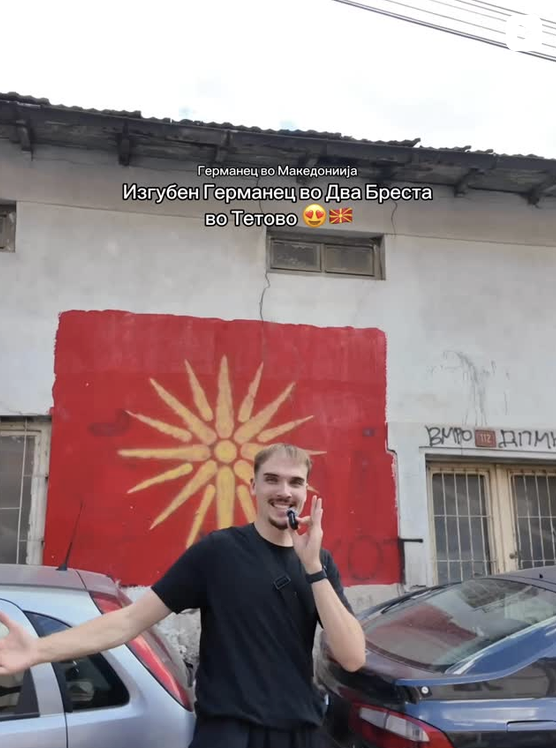
Finn Wattchow, the German creator behind @finnmacedonia, has built perhaps the cleanest version of this exchange. His premise is almost disarmingly simple: a German living in Macedonia, learning the language, visiting towns, trying foods, asking questions, showing affection. But the simplicity is deceptive. Finn’s posts understand something many official campaigns miss: Macedonians do not only want their country admired. They want it specifically recognized.

Finn laughs at the name Krivogashtani, falls hard for Širok Sokak, proudly adopts a Vevčani passport, and, before long, appears in full traditional Macedonian dress from Narodni Nosii. The whole thing is absurdly, irresistibly watchable.

A generic travel post asks viewers to look at a view. Finn’s posts ask viewers to locate themselves. Are you from this town? Did I say this correctly? Is this the best place for burek? Where should I go next? The audience is not treated as a mass but as a map. Every correction is a signal. Every recommendation is a future itinerary. Every comment becomes proof that the place named in the video is not background but belonging.

This is why the account can feel less like tourism than like a rolling census of Macedonian pride. Place names become hooks. Holidays become emotional triggers. Sports become tribal infrastructure. Language-learning becomes a ritual of supervised intimacy. Finn’s foreignness is not incidental to the appeal. It is the mechanism. A Macedonian saying “Bitola is beautiful” may receive agreement. A German saying it receives circulation.

That is the slightly uncomfortable truth beneath the charm of the genre: outsider validation is part of the product. The foreign creator does not simply show Macedonia to the world. He shows Macedonia to Macedonians through the eyes of someone who did not have to care.

Outside validation is often described as vanity, but in small or misrecognized places it functions more like psychic infrastructure. Macedonia’s image has long been produced under pressure: named by others, disputed by others, explained to others, corrected for others. In that context, the foreign creator becomes more than a visitor. He becomes a mirror with borrowed authority. His attention seems to arrive from outside the local argument, and for that reason it can feel cleaner, less contaminated by obligation. He did not inherit the village rivalry. He does not owe affection to Strumica, Bitola, Kratovo, or Vevčani. So when he praises them, the praise appears voluntary.

This is why the response can be so intense. The pleasure is not simply that a foreigner likes Macedonia. It is that the foreigner appears to confirm a private suspicion: that the place was always worthy, even if the world failed to notice. The video offers a brief release from the labor of self-explanation. For thirty seconds, Macedonia does not have to argue for its complexity, beauty, humor, or depth. Someone else has seen it. Someone else has said it aloud.

But the same mechanism that flatters also exposes a wound. The need for outside recognition can make attention feel like rescue, even when it is only content. A badly pronounced town name becomes forgivable if the affection seems real. A shallow observation can travel widely if it arrives from the right outsider. The stranec is rewarded not only for insight, but for choosing to look at all. In this economy, being seen is sometimes mistaken for being understood.

Social platforms intensify that dependency because they make validation measurable. Likes, comments, stitches, local-news pickups, diaspora shares: all of them turn recognition into visible proof. The audience is not merely watching the foreigner discover Macedonia; it is watching itself be discovered. Each share says, in effect, look, they see us too. The design of the platform converts a national feeling into a feedback loop.

This does not make the exchange false. It makes it psychologically charged. The best foreign creators succeed because they enter that charge without fully controlling it. They offer Macedonia a reflection, but the reflection is unstable: part admiration, part misunderstanding, part performance, part projection. The country looks back and sees itself differently for a moment—not as a solved identity, but as a place still negotiating the terms of its visibility.
Screenshot of Richard Hayward's feed showing a Vardar River video post.
@therealsqm

Richard Hayward, the British creator known as SideQuestMerchant and @therealsqm, works from a different playbook. If Finn’s content is built on recognition, Richard’s is built on premise. He does not merely visit places; he inserts himself into situations with enough absurdity that the video itself can become a local event. Dressing like a Гасер from Aerodrom, floating down the Vardar in an inner tube, traveling through the tunnels beneath Kale—his format is not “look where I am.” It is “watch what happens if a foreigner does this here.” This writer could not stop smiling while watching the videos.

"After I graduated from university in the U.K., I decided now was the time to commit myself fully to my dream — being a YouTuber in Macedonia — and so I moved to Macedonia just three days after my final exam and met up with my team who I had hired and assembled via Facebook and we started filming," Hayward said. "It turns out that long-form content is a particular struggle in Macedonia, but our short-form was where we found real success and we were able to show off the great national character as well as quirky traits that the country had to offer."

That distinction matters. Richard turns Macedonia into a production environment: setting, character, obstacle, punch line, and argument. The country supplies not just scenery but friction—polluted rivers, rituals, bureaucracy, curiosity, embarrassment, civic pride, civic shame. His Vardar content is the clearest example. What begins as a stunt becomes, once the garbage appears, something closer to a public-service announcement disguised as a joke. The comedy gets people to watch. The river gives them something to fight about.

A successful Macedonia video has to travel across several publics at once: the Reel, the YouTube episode, the local news item, the group-chat link, the diaspora share. In a larger market, the same stunt might disappear into the feed. In Macedonia, where foreign attention still feels unusual and the creator field is less crowded, it can become conversation. Richard’s advantage is not only creativity. It is market selection.

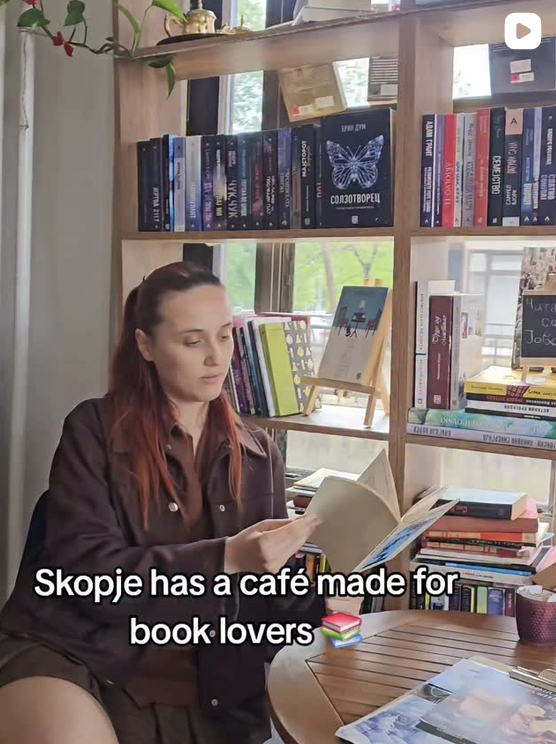
The Turkish creator behind @ozitheexpat offers a quieter lane. Her Macedonia is not spectacle but livability: Skopje parks, food, errands, walks, cafés, the small rituals by which a temporary move becomes ordinary life. Beside louder personalities, this kind of content can look modest. But it performs a different and important function. It sells the city back to itself.

Skopje is often described by its own residents in a tone of exhausted intimacy. It is chaotic, beloved, overbuilt, ugly, social, changed, impossible, home. Her work benefits from not being trapped inside that inherited argument. She can notice the city without needing to litigate it. A café is just a café. A walk is just a walk. A kind exchange is allowed to remain kind. For locals, this can be surprisingly persuasive. A city that feels worn down from the inside can appear newly usable when narrated by someone who chose it.

Mustafa Ahmed, @travelsofmozzy, brings the digital-nomad frame. A Somali-Norwegian freelancer with an IT background, he presents Macedonia as part of a broader Balkan proposition: affordable, social, under-promoted, central, surprisingly comfortable.

For remote workers and small digital operators, that is the pitch: lower costs than Western Europe, less saturation than the obvious nomad hubs, enough urban life to function, enough unfamiliarity to keep producing content. The country’s weaknesses become part of the opening. Limited global image, smaller market, imperfect infrastructure, fewer polished templates—these are inconveniences, but they are also space. A creator can define a category before the category becomes crowded.

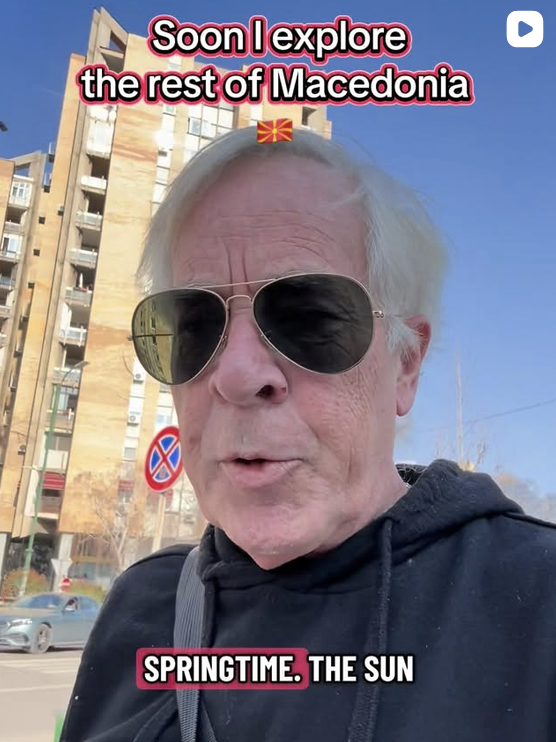
Then there is Brett, the older American behind @brettandbear, whose presence widens the story because he does not fit the young-expat-growth-hacker mold. His work describes American solo travel through the Balkans: Skopje, Matka Canyon, Ohrid, Kumanovo, hopping up to Belgrade, food, cafés, barbers, street cats, ordinary Balkan life. His appeal is not polish. It is presence.

An older man with a thick Alabama accent walking around Skopje is already a premise, not because it is exotic in some cheap way, but because it interrupts the expected demographics of travel content. He is not selling the fantasy of early retirement in paradise or the frictionless laptop life. He seems to move through the place more slowly, noticing what an optimized creator might edit out: cats, sidewalks, cafés, pauses, small talk, the texture of ordinary public life.

That slowness has its own digital value. In a feed full of compressed advice and overproduced enthusiasm, the inefficient observer can seem more trustworthy. Brett’s lane suggests that Macedonia content does not have to be only adrenaline, youth, or national affirmation. It can also be a form of public wandering.

Together, these creators reveal why Macedonia works unusually well online. It is not “undiscovered,” a word that usually says more about the discoverer than the place. It is under-posted relative to the intensity of feeling it produces. The country has a large emotional surface area: local pride, diaspora longing, name politics, food memory, city rivalry, village identity, religious ritual, sports loyalty, linguistic sensitivity. But much of that feeling has not yet been converted into globally legible content.

That is the opening.

The smartest foreign creators do not invent Macedonia. They translate it into platform behavior. Finn turns local identity into comments. Richard turns civic absurdity into spectacle. Mustafa turns Macedonia into a nomad case study. Brett turns walking around into a kind of slow ethnography. Each finds a way to make the country clickable without making it completely generic.

Finn Wattchow standing in front of a painted Macedonian flag in a social media video screenshot.

This is also why the audience participates so intensely. Macedonians online do not behave like a passive tourism demographic. They behave like stakeholders. People do not simply watch a video about their town; they audit it. They check the pronunciation, the politics, the food, the flag, the caption, the tone, the use or avoidance of “North.” A foreign creator entering this space receives engagement, but also supervision.

For a digital business reader, that supervision is the moat. It means the audience cares enough to correct. And an audience that corrects is an audience that returns.

The creator economy usually treats niches as interest categories: fitness, beauty, finance, travel. Macedonia shows that a niche can also be a wounded public image. A country that feels overlooked will reward attention, but only if the attention feels specific. A polished “Top Ten Places to Visit” reel may produce mild consumer interest. A small-town prompt can activate belonging. The former asks to be watched. The latter asks to be claimed.

The diaspora strengthens the loop. Macedonia content is rarely only domestic. A video from Skopje also travels to Toronto, Melbourne, Chicago, Malmö, Zurich, and wherever else Macedonians have built second lives. For diaspora viewers, foreigner content offers a double pleasure. It shows the place they remember, or inherited, and confirms that someone outside the family argument finds it worthy of attention. The validation can be sentimental, but it is also practical distribution. Diaspora networks share aggressively when they feel represented.

There is, of course, something uneasy in all this. The foreigner can be over-rewarded for noticing what locals have always known. They can turn national insecurity into engagement. They can become a mascot.

But the better accounts complicate their own flattery. Richard shows environmental neglect. Mustafa points toward practical barriers. Ozi's work is domestic rather than grandiose. Finn allows himself to be corrected. Brett does not seem to be packaging the country into a sleek relocation funnel. Their best content succeeds because it leaves room for Macedonia to remain argumentative, funny, defensive, hospitable, proud, wounded, and unresolved.

That unresolved quality may be the real attraction. More famous destinations arrive on the feed already processed. Paris has a script. Lisbon has a script. Bali has several scripts, all exhausted. Macedonia’s script is still being written in public, and foreign creators have become unlikely participants in the drafting.

What the stranci found in Macedonia was not an undiscovered country, but an under-translated one: a place dense with village loyalties, private jokes, old grievances, ordinary beauty, and an audience unusually willing to participate in its own representation. What Macedonia found in them was more complicated. Not saviors, not experts, not neutral observers, but people whose attention could flatter, irritate, expose, and reframe.

"Macedonia truly has so much potential," Hayward said. "The one thing I will always bring up is the warmth of the people. Macedonia is a close-knit country where friendships mean a lot. I will never forget the ones I made." He continued: "I really do believe Macedonians wants to make the country better and have international dialogue and friends, and this was great to see, and I will forever encourage it."

The best of these creators do not explain Macedonia so much as activate a country between countries: Macedonia as it is lived, Macedonia as it is remembered, Macedonia as it must appear to be believed. They are not natives, but they are no longer tourists. They are the new locals, made local by attention, correction, repetition, and the strange intimacy of being watched back.