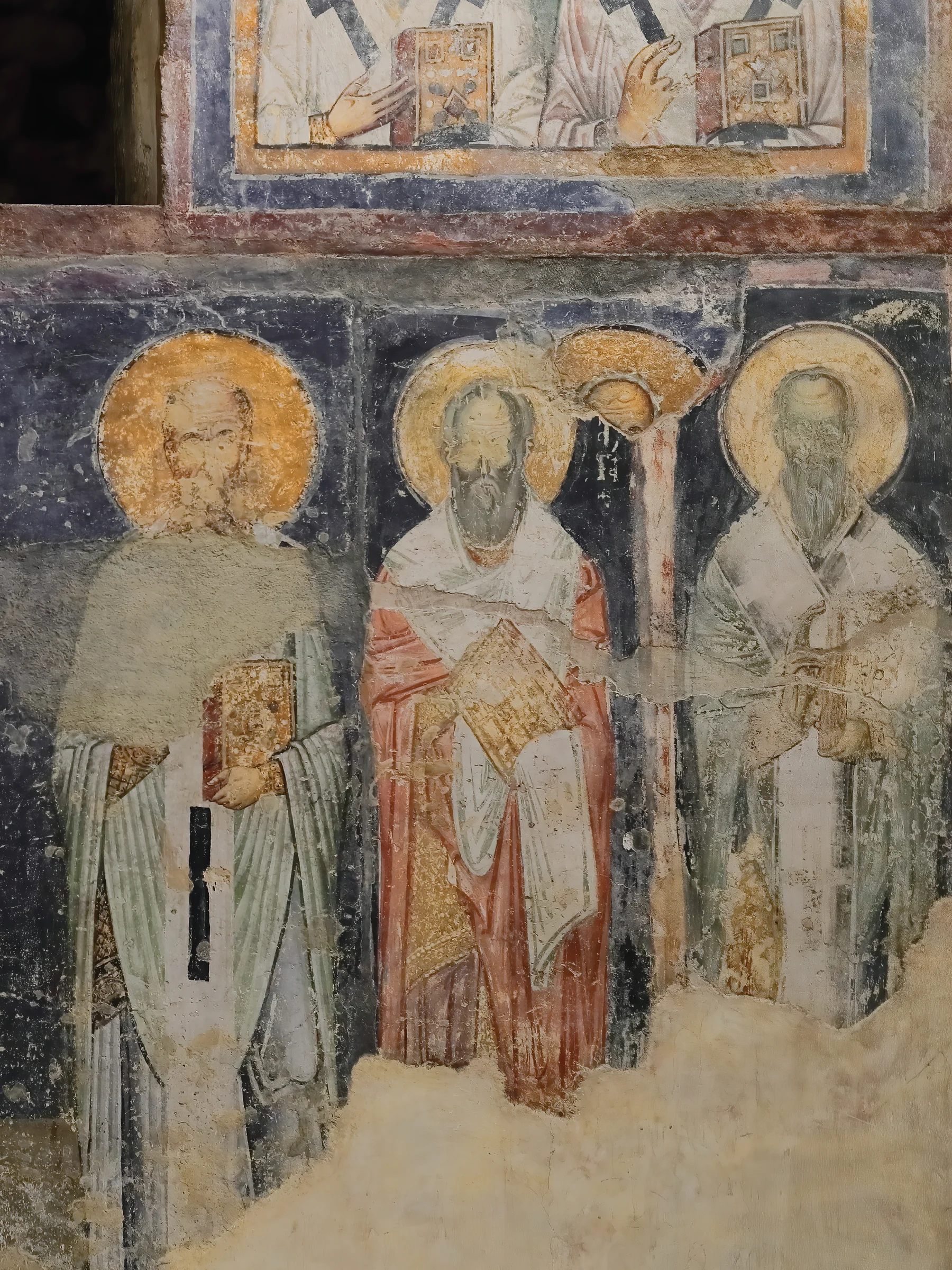
The history of Macedonian art is repeatedly described through inheritance: the inheritance of Byzantium, of Ohrid, of the icon, of the monastery workshop. But inheritance is too passive a word for what the objects actually do. From the eleventh-century frescoes of Saint Sophia to the nineteenth-century icons of Dicho Zograf and the carved walnut iconostases of the Mijak masters, the most consequential Macedonian works are not acts of preservation alone. They are acts of formal pressure. Each period takes an established visual language—the frontal saint, the gold ground, the liturgical cycle, the basilica, the icon screen—and pushes it toward a new intensity.
The phrase “Macedonian Renaissance” properly refers, in Byzantine art history, to the cultural and classicizing revival associated with the Macedonian imperial dynasty after the end of Iconoclasm, particularly between 867 and 1056. Yet in Macedonia the term acquires a longer and more visually compelling afterlife. The classical composure of Middle Byzantine painting is followed by the psychological compression of Nerezi, the nervous linearity of Kurbinovo, the narrative congestion of Peribleptos, and, centuries later, by the resurgent monumentality of nineteenth-century church building, icon painting, woodcarving, and domestic architecture.
These moments do not form one uninterrupted style. What connects them is something more concrete: an extraordinary confidence in the ability of line and surface to produce presence. Macedonian art rarely treats the wall as neutral support. The wall becomes a field of bodies; the wooden screen becomes vegetation, narrative, and architecture at once; the icon panel becomes a compact mechanism of recognition. Even when the figure approaches naturalism, it never fully submits to the illusion of an open window. The image remains attached to its material surface, and it makes that attachment expressive.
The Classical Gravity of Saint Sophia
Any survey must begin in Ohrid, not because the city contains a convenient sequence of monuments, but because Saint Sophia establishes the scale of the problem. Its principal eleventh-century fresco program was created during the episcopate of Archbishop Leo, 1037–1056. Branislav Todić has argued that Leo was not simply the patron but the decisive intelligence behind the iconographic program: its saints, liturgical subjects, and arrangement were deliberately coordinated rather than accumulated as conventional decoration.
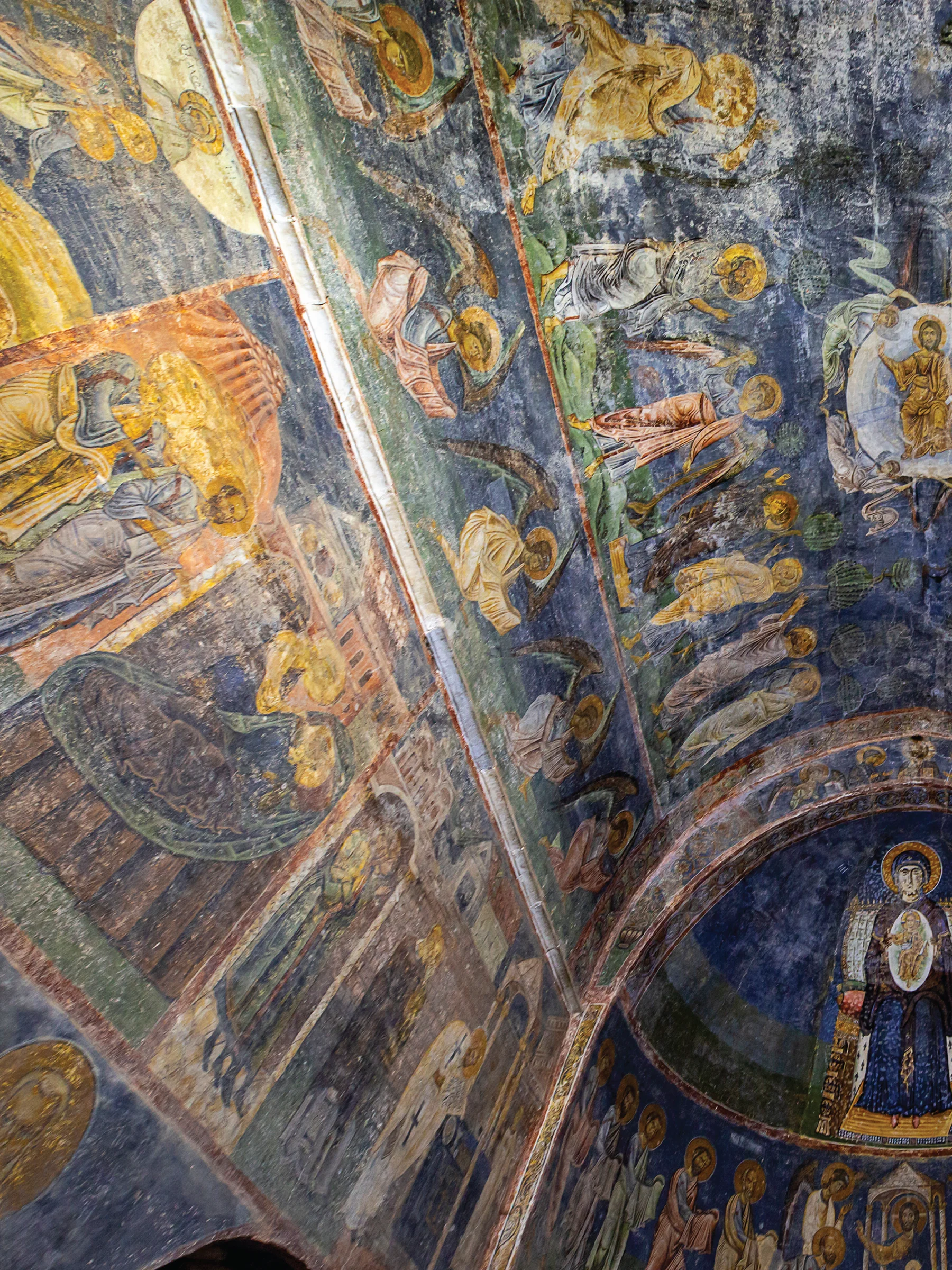
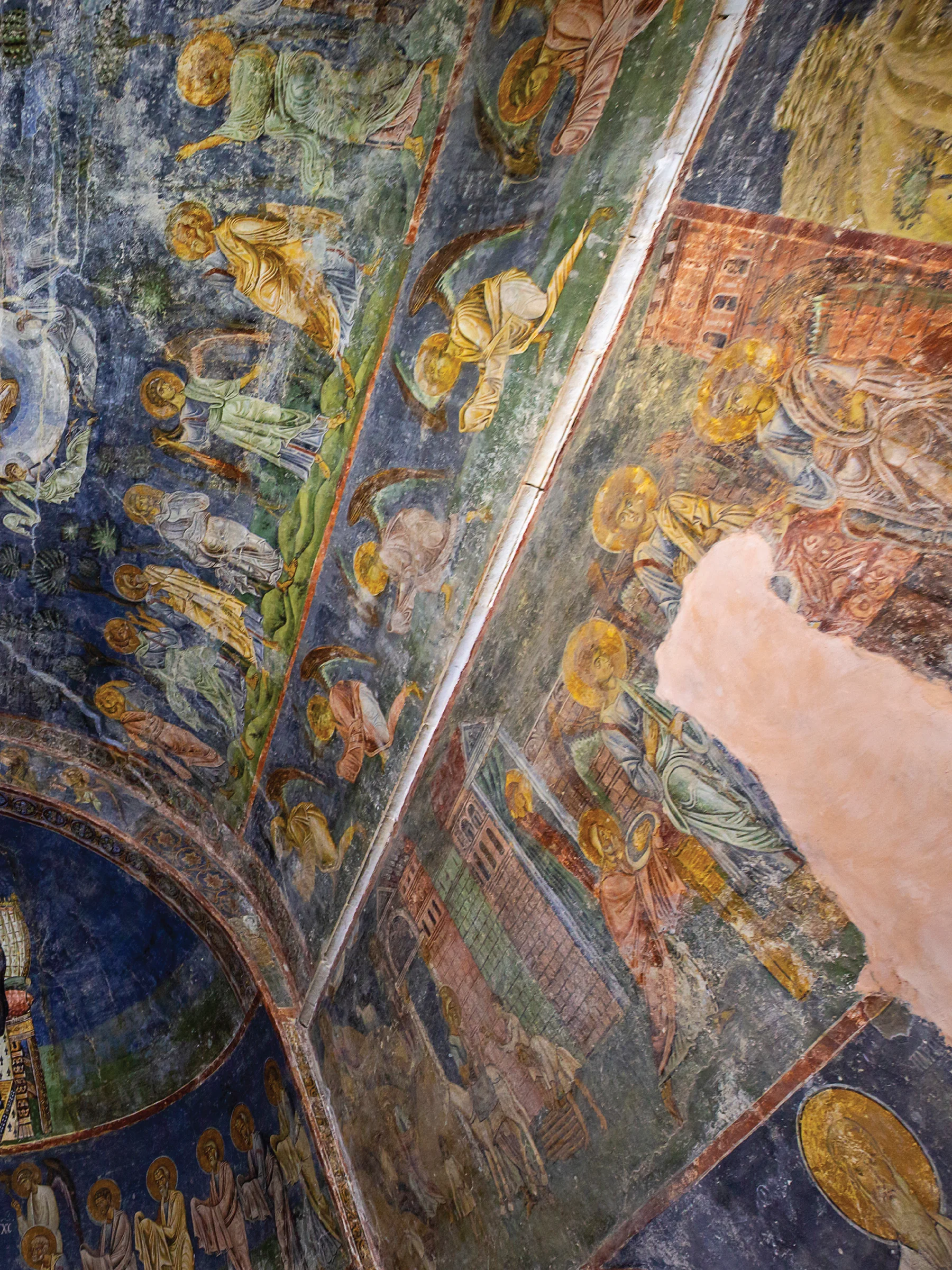
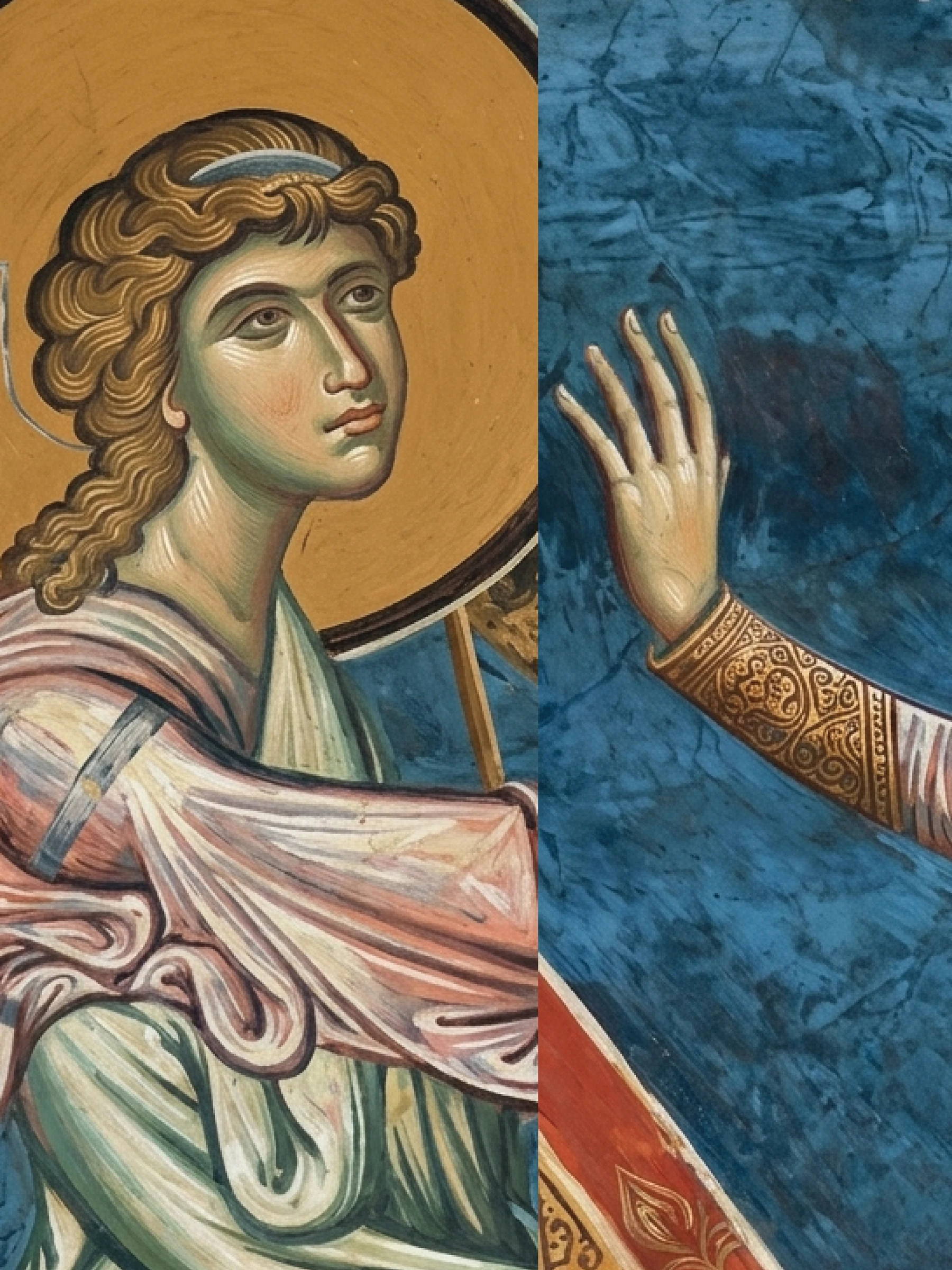
Yet before the program is read, it is felt. Entering the sanctuary, one confronts a painted order in which the human body has become architectural. The figures are broad, heavily outlined, and slow. Faces are constructed from long noses, enlarged eyes, shadowed sockets, and abrupt planes of light. The modeling does not dissolve the figure into atmosphere; it consolidates it. Flesh appears dense, almost mineral.
In the apse, the enthroned Virgin occupies the conch above the Communion of the Apostles, where Christ officiates before the altar. The composition is not organized according to the casual optics of observed space. Its proportions are liturgical rather than naturalistic: figures expand or contract according to their role, and the architecture inside the painting clarifies the action rather than producing convincing depth. The ciborium, altar, apostles, and duplicated figure of Christ establish a solemn visual rhythm across the curved wall.
The fresco is often approached as theology rendered visible, which it is. But its pictorial achievement is equally specific. The curve of the apse prevents the scene from being perceived all at once. The apostles advance around the sanctuary wall in a measured sequence; the architecture of the church converts painted procession into actual spatial movement. Otto Demus’s account of Byzantine church decoration as an integrated spatial system is particularly relevant here: the image does not sit on the architecture like a framed painting. It becomes legible through the architecture.
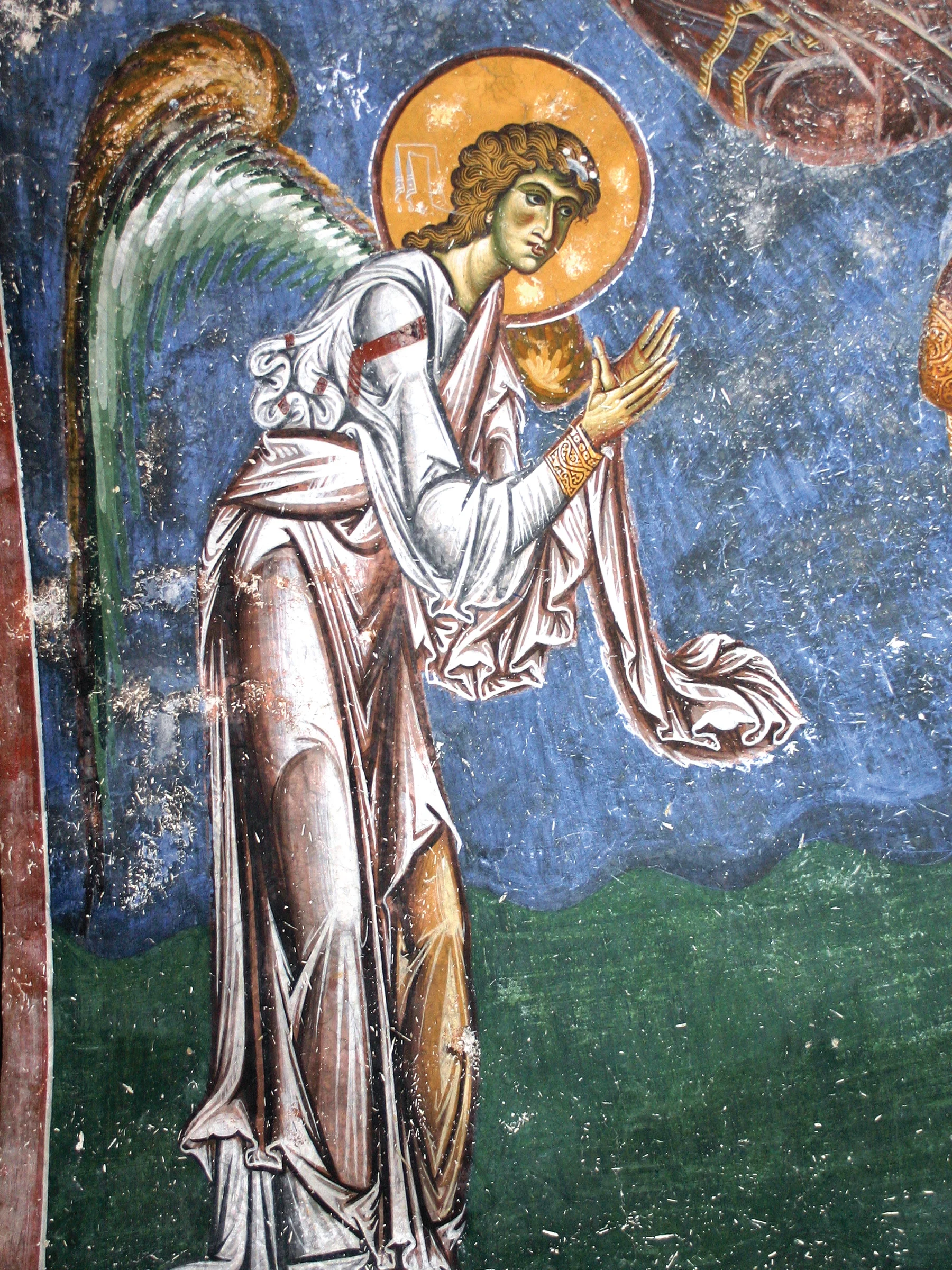
The palette at Saint Sophia has none of the jeweled dematerialization associated with mosaic. Ochres, blue-greens, earthen reds, whites, and dark contours retain the granular opacity of fresco. The colors bind the figures to the plaster. This material weight is essential to their authority. Even when a robe is articulated through fine linear folds, the body remains compact. Light does not enter from outside the image; it is laid onto the face and garment in discrete strokes.
Compared with the aristocratic manuscripts usually invoked to define the Byzantine Macedonian Renaissance, Saint Sophia is less self-consciously antique. The classicism is present in the measured contrapposto of certain figures, the controlled fall of drapery, and the volumetric coherence of heads and bodies. But classical form has been stripped of display. It has become an instrument of monumentality.
The result is not realism but gravity. Saint Sophia establishes the body as a stable theological and pictorial unit: a form that can occupy the wall without appearing either trapped by it or detached from it.
Nerezi: The Invention of Intimacy
A century later, at Saint Panteleimon in Gorno Nerezi, the body begins to break open. The church is securely dated by its inscription to 1164 and preserves one of the major ensembles of Komnenian fresco painting. It falls outside the Macedonian dynasty and its Renaissance in the strict chronological sense, but any history of the art of Macedonia that stops at dynastic periodization misses the transformation that occurred here.
The famous Lamentation is often reproduced as an early anticipation of Italian emotional naturalism. This comparison is understandable and mostly unhelpful. Nerezi does not become important because it resembles something that will later happen elsewhere. Its importance lies in the way Byzantine line is made to carry affect without surrendering the image’s formal discipline.
Christ’s body lies diagonally across the foreground, its extended shape establishing the composition’s emotional horizon. The Virgin bends over him until her face approaches his; Saint John collapses toward the dead hand; the surrounding mourners produce a chain of inclinations, gestures, and interrupted contours. Grief is not represented through facial expression alone. It travels through the entire composition as a series of bent axes.
The landscape remains spare. A rocky ground rises behind the figures, but it does not open into continuous natural space. Instead, its slopes echo the downward pull of the bodies. The image’s emotional force comes from this coordination of figure and setting: every form is made to lean toward the corpse.
The painters at Nerezi were attentive to minute physical signs—hands touching flesh, cheeks pressed together, torsos curved by mourning—but the scene never becomes anecdotal. The figures remain types even as they appear to suffer individually. This tension between canonical identity and bodily particularity is the fresco’s great invention.
Hans Belting’s distinction between an image that is contemplated aesthetically and an image encountered as a presence is useful here. At Nerezi, however, presence is no longer secured by frontal immobility alone. It is produced through contact. The painted body of Christ becomes the point toward which every other body is drawn.
The effect is intimate without becoming private. This is public grief, staged on the wall at monumental scale. The fresco allows the congregation to approach sacred history not through illusionistic entry into a distant past, but through a tightly compressed choreography of touch.